
Picture the most famous warrior in Christendom. He has conquered Cyprus, led the capture of Acre, and gone toe to toe with Saladin. His nickname literally means “Lion Heart”. And now picture him in a grubby tavern on the edge of Vienna, a week before Christmas, dressed as a servant, turning a chicken on a stick.
That, according to at least one medieval chronicler, is how King Richard I of England was caught. It’s one of the great “you had one job” moments in European history, and it ended with a king locked in a castle above the Danube and a mountain of silver that helped pay for the city of Vienna as we know it.
The Flag That Started It All
To understand why Richard was sneaking through Austria in disguise, we have to rewind to the Holy Land. On 12 July 1191 the city of Acre surrendered to the crusader armies. Duke Leopold V of Austria, of the Babenberg family, planted his banner in a prominent spot and claimed the same share of the spoils as the kings.
Richard was not impressed. Leopold’s banner was thrown down from the walls, either on Richard’s orders or with his cheerful approval. To make matters worse, Richard was later accused of being behind the murder of Leopold’s cousin, Conrad of Montferrat. Leopold went home in a sulk of truly medieval proportions. Never insult a man’s flag; he may own the roads you need later.
A Very Bad Road Trip
On 9 October 1192, Richard set sail for home. Then everything went wrong. A shipwreck forced him to travel overland, straight through the Holy Roman Empire, where he had more enemies than friends. He travelled in disguise with a handful of companions, a plan the German historian Dieter Berg has described as a “strange and at the same time amateurish game of hide-and-seek”.
Amateurish is generous. Richard was a king who was used to being a king. He was not used to being inconspicuous. Word of a suspicious, suspiciously rich traveller spread ahead of him, and on 21 December 1192 the party reached Erdberg, then a village just outside Vienna, today part of the city’s 3rd district. Leopold’s territory. Oops.
Death by Chicken (Almost)
What happened next depends on which chronicler you read, and they disagree enthusiastically. Some say Richard was disguised as a pilgrim, others as a merchant. Some blame a servant who went shopping in Vienna with far too much money and a pair of fancy gloves tucked in his belt.
The best version comes from the Benedictine chronicler Otto of St. Blasien, who sets the scene in a shabby inn. Richard, playing the part of a lowly kitchen hand, had stuck a chicken on a wooden spit and was turning it himself. Unfortunately, he was not quite convincing as a servant: he forgot to take off the magnificent ring he always wore. An Austrian veteran of the crusade happened to be in the tavern, recognised the ring and the man wearing it, and ran to fetch his lord. When Leopold arrived and saw the King of England holding a roast chicken, Otto tells us, he first laughed at him and then arrested him.
Is it true? Historians are cautious. The sources contradict each other so thoroughly that the real circumstances are probably lost for good. But as stories go, “Lionheart undone by poultry” is very hard to beat. A plaque in the courtyard of Erdbergstraße 41 still marks the spot traditionally linked to the capture. The chicken, sadly, gets no mention.
A Room with a (Danube) View
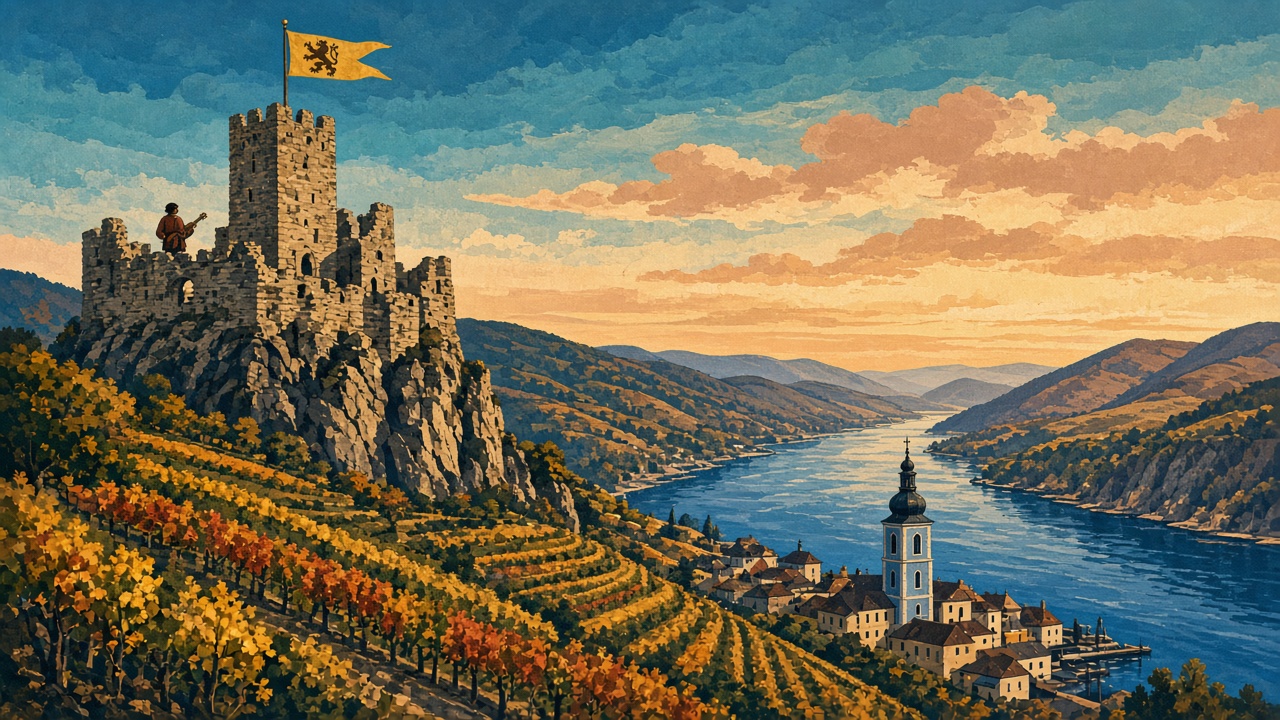
Leopold handed his royal prisoner to Hadmar II of Kuenring, one of the most powerful nobles in the Babenberg lands. The Kuenrings had built a rocky fortress high above the village of Dürnstein in the Wachau valley, and there Richard was held from December 1192 until the spring of 1193, reportedly in a manner befitting a knight. As prisons go, it had a spectacular view: the Danube curling below, vineyards climbing the slopes, and absolutely no way to escape it.
It’s also where the most romantic legend of all was born. According to a tale first written down in the 13th century, Richard’s loyal minstrel Blondel wandered from castle to castle singing a song only he and the king knew. One day, beneath the walls of a lonely fortress, a familiar voice sang the second verse back. Lovely story. Almost certainly invented. Today a rusty iron sign at the gate of the ruin is stamped with one honest word: “LEGENDE”. Austrians are nothing if not precise.
The Most Expensive Prisoner in Europe
Leopold soon passed Richard on to his boss, Emperor Henry VI, who held the king mostly at Trifels Castle in the Palatinate. Under the Treaty of Worms in June 1193 the ransom was set at 150,000 marks of silver, roughly three times the English crown’s annual income. Back home, England was taxed hard to raise the money. Richard was finally released in Mainz on 4 February 1194, after around 14 months in captivity, only a few of which were actually spent in the Wachau.
And Leopold’s share? He spent it on infrastructure, which is the least romantic thing anyone has ever done with a king’s ransom. He set up a mint in Vienna, built a new, greatly expanded city wall, and founded the town of Wiener Neustadt. So the next time you walk Vienna’s Ringstraße, which follows the line of the city’s later fortifications, spare a thought for an English king who funded the original building project with his own freedom.
Karma, Medieval Edition
Leopold didn’t get to enjoy his windfall for long. Richard was a crusader under the protection of the Church, so Pope Celestine III excommunicated the duke in 1194. At the end of that year, Leopold fell from his horse in Graz and suffered a badly broken leg. He died on 31 December 1194 and was buried at Heiligenkreuz Abbey. Medieval chroniclers, not known for their subtlety, did not have to work hard to find the moral.
Visiting the Lionheart’s Prison Today
Dürnstein is one of the prettiest villages on the Danube, and it’s an easy pairing with the rest of the Wachau. Look up from the cobbled lanes and you’ll spot the castle ruin on its rocky crag, with the famous blue-and-white tower of Dürnstein Abbey shining down by the river.
You can see it on our Wachau Wonders and Magical Hallstatt semi-private day trip, which combines a stroll through Dürnstein with Melk Abbey, Lake Traunsee and the fairy-tale lakeside village of Hallstatt. Prefer a coach day out? Our Hallstatt, Dürnstein and Melk day trip from Vienna by coach covers the same highlights. And if you’re staying in the city, take a look at our 11 unforgettable places you can’t miss in Vienna for more stories hiding in plain sight.
Follow the Lionheart up the Danube
Richard came to Austria in disguise and left it a lot poorer. You can do the trip the other way round: in comfort, with a guide who knows every legend worth telling, and with no risk of being arrested over dinner.
👉 Book your Wachau and Hallstatt semi-private day trip from Vienna and wear whatever rings you like.
Image: Created with AI